


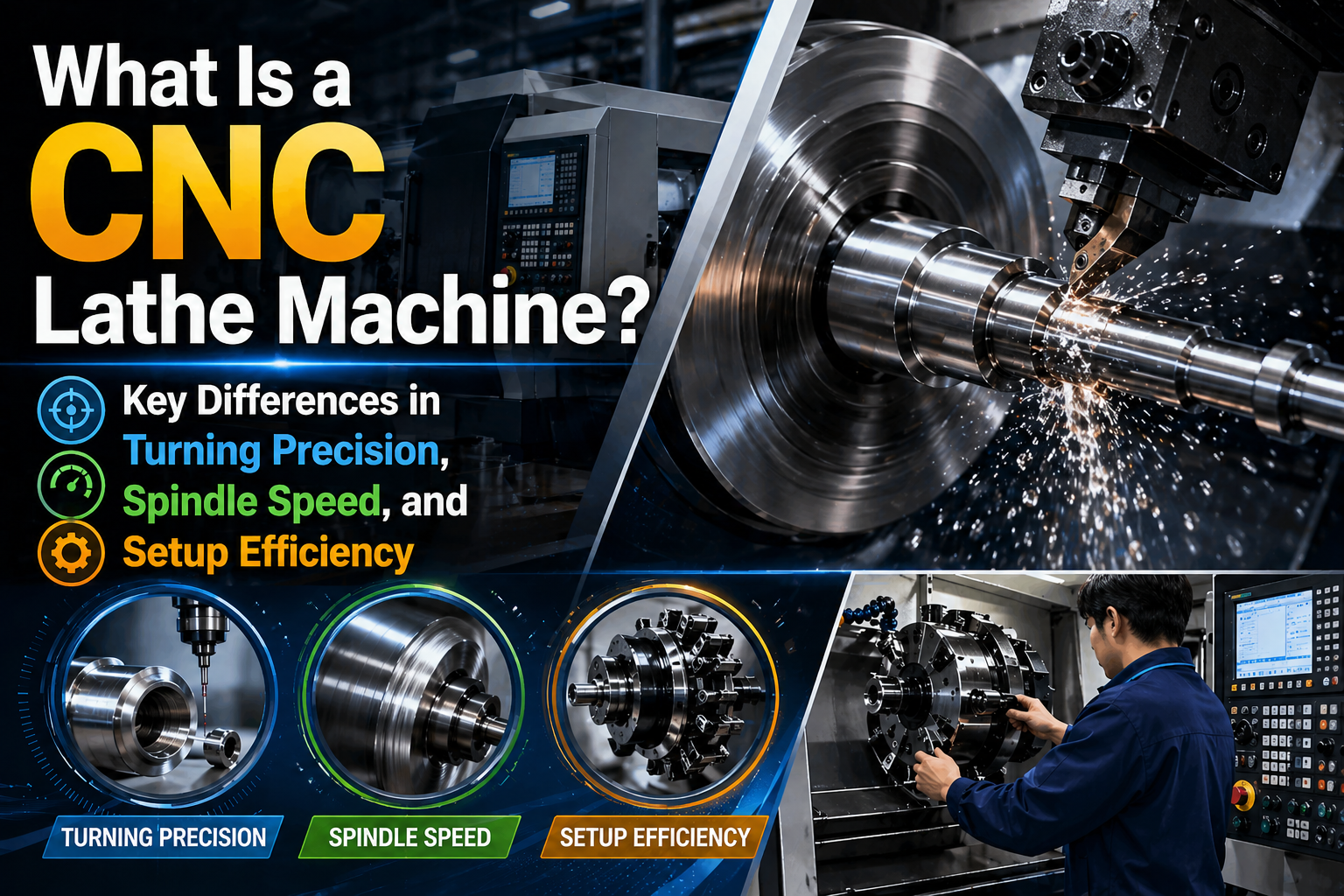
For industrial manufacturers evaluating their next capital equipment investment, the CNC lathe machine remains one of the most versatile and essential assets on the production floor. Whether you are producing automotive shafts, aerospace components, precision molds, or medical device housings, understanding what a CNC lathe machine is used for — and how its core performance parameters differ across configurations — is the foundation of a sound procurement decision.
This guide breaks down the primary industrial applications of CNC lathe machines, then examines three performance dimensions that most directly impact your production outcomes: turning precision, spindle speed, and setup efficiency.
What Is a CNC Lathe Machine?
A CNC (Computer Numerical Control) lathe machine is a subtractive manufacturing tool that rotates a workpiece along a central axis while a cutting tool removes material to produce cylindrical, conical, or complex turned profiles. Unlike manual lathes, CNC lathes execute programmed toolpaths automatically, enabling consistent part geometry across high-volume production runs with minimal operator intervention.
Modern CNC lathes support a range of operations including turning, facing, threading, boring, grooving, knurling, and parting. Advanced configurations integrate live tooling, enabling milling, drilling, and tapping in a single clamping — significantly reducing inter-process handling time.
Core Industrial Applications of CNC Lathe Machines
Automotive and Motorcycle Components
CNC lathe machines are central to the production of crankshafts, camshafts, brake drums, axle shafts, and bearing housings. The automotive sector demands tight dimensional tolerances — typically within ±0.005 mm — and high cycle repeatability across tens of thousands of parts per batch. CNC lathes deliver the automated consistency that manual turning cannot sustain at volume.
Aerospace Structural Parts
Aerospace components such as turbine shafts, landing gear pins, and hydraulic actuator bodies require both ultra-tight tolerances (often ±0.002 mm or finer) and material versatility across titanium, inconel, and hardened steel alloys. CNC lathe machines with rigid construction and thermal compensation are the preferred solution for this high-value segment.
Precision Mold and Die Industry
Core pins, ejector pins, sprue bushings, and guide pillars for injection molds all require turned profiles with surface finishes of Ra 0.4 μm or better. CNC lathes configured for hard turning reduce the need for downstream grinding operations, compressing lead time and tooling costs.
Medical Device Manufacturing
Bone screws, implant stems, surgical instrument handles, and catheter fittings are produced in small-to-medium batches with extremely high accuracy requirements. CNC lathes capable of Swiss-type sliding headstock operation or sub-spindle work are common in medical device job shops.
Defense and Energy Equipment
Hydraulic valve bodies, missile guidance housings, pump impellers, and turbine rotors fall under this category. Long cycle times, large turning diameters, and stringent material traceability requirements define this segment.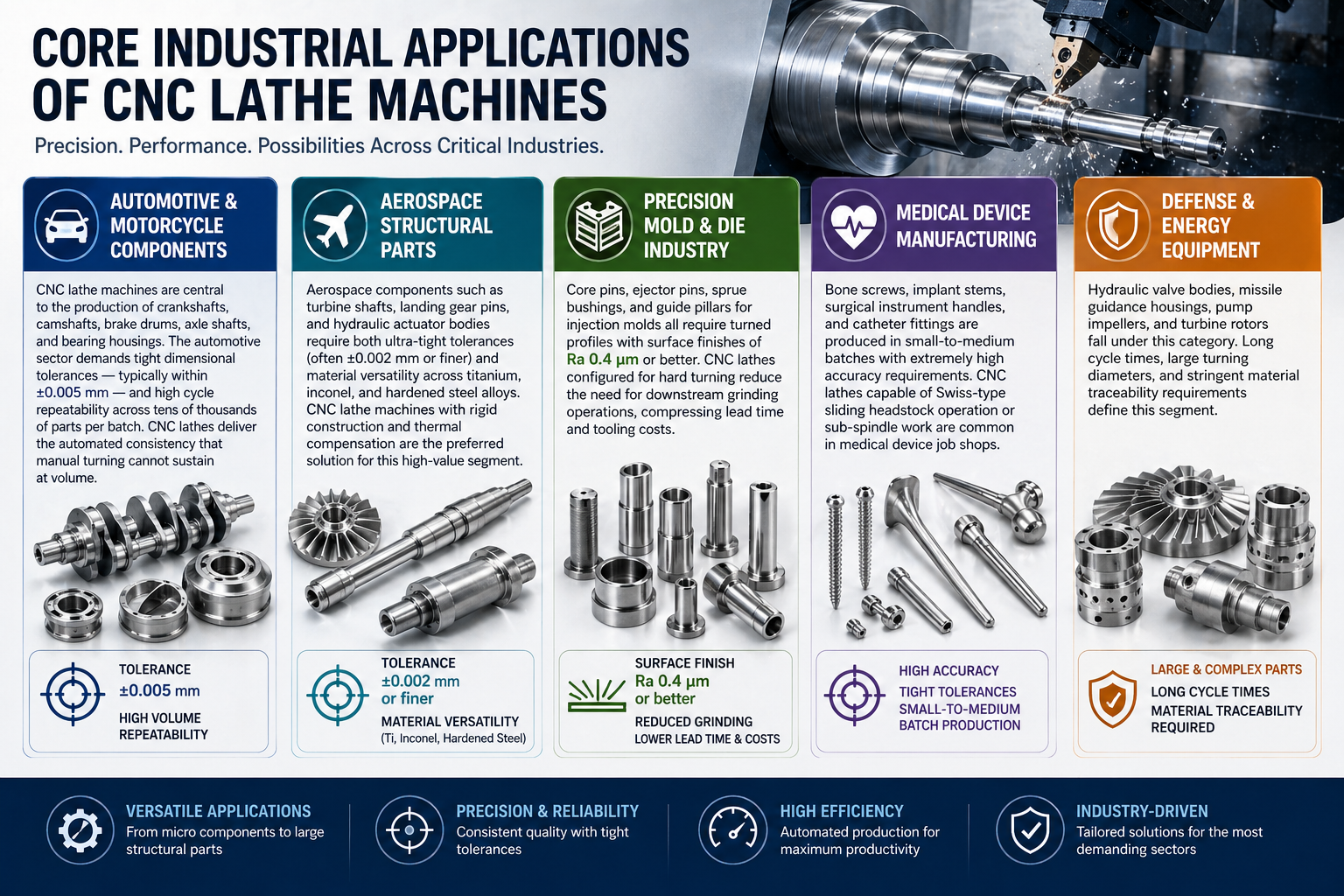
Key Difference 1: Turning Precision
Turning precision is defined by the machine's geometric accuracy, thermal stability, and rigidity under cutting loads. It is expressed as dimensional tolerance (e.g., ±0.003 mm) and surface finish (Ra value, typically 0.4–3.2 μm for standard turned parts).
Flat bed CNC lathes provide a rigid casting structure suited for heavy interrupted cuts on large-diameter workpieces. Precision is adequate for general engineering tolerances but may require secondary finishing for sub-micron surface requirements.
Slant bed CNC lathes position the turret at a 30–45° angle, directing cutting forces toward the machine base and away from the guideway. This geometry reduces vibration and thermal displacement, enabling consistently tighter tolerances — typically ±0.002 to ±0.005 mm in sustained production — without the manual rework associated with flat bed configurations.
For manufacturers targeting aerospace or medical precision grades, slant bed construction is the preferred baseline. Flat bed designs remain cost-effective for general-purpose shaft turning where Ra 1.6 μm and ±0.01 mm tolerances are acceptable.
Key Difference 2: Spindle Speed
Spindle speed (RPM) directly determines material removal rate, surface finish quality, and tool life. Higher spindle speeds enable faster cutting of small-diameter features and non-ferrous materials; lower-speed, high-torque spindles are suited for large-diameter steel turning.
| Machine Type | Typical Max Spindle Speed | Best Suited For |
|---|---|---|
| Standard flat bed CNC lathe | 2,000 – 3,500 RPM | Large diameter, heavy-duty steel |
| Slant bed CNC lathe | 4,000 – 6,000 RPM | Medium diameter, mixed material batches |
| High-speed CNC lathe / turning center | 6,000 – 12,000 RPM | Small diameter, aluminum, brass, plastics |
| Swiss-type CNC lathe | 10,000 – 15,000 RPM | Micro-components, medical, watchmaking |
For automotive production of steel shafts (diameter 30–80 mm), a slant bed machine in the 4,000–6,000 RPM range provides the optimal balance of surface finish and tool life. For medical micro-parts below 12 mm diameter, Swiss-type or high-speed platforms are necessary to achieve acceptable cycle times and surface integrity.
Spindle motor power (typically 7.5–22 kW on industrial CNC lathes) also determines depth-of-cut capacity during roughing passes. Procurement teams should evaluate spindle power in conjunction with RPM range rather than RPM alone.
Key Difference 3: Setup Efficiency
Setup time — the non-productive time between the last good part of one job and the first good part of the next — is the single largest hidden cost in high-mix, low-to-medium volume CNC lathe production.
Manual turret indexing (common on entry-level CNC lathes) requires operators to physically position and clamp toolholders between jobs. Setup times of 30–90 minutes per changeover are typical, eroding machine utilization on short-run jobs.
Automatic tool changers (ATC) and VDI/BMT turrets reduce tool change time to seconds. Driven live-tool turrets with 12 or more stations allow complex milled features to be completed in a single clamping, eliminating secondary operations entirely.
Sub-spindle and bar feeder integration further reduces per-part handling. With a bar feeder, raw material is automatically indexed forward between parts, enabling unattended overnight runs. A sub-spindle picks up the partially machined part from the main spindle, completes backworking operations, and ejects finished parts — all without operator contact.
For manufacturers running more than three distinct part families per shift, investing in a CNC lathe with driven live tooling and bar feeder compatibility reduces per-part setup cost by 40–60% compared to entry-level configurations.
GRIMA KL-400: Engineered for Industrial Precision Turning
GRIMA's KL-400 CNC Lathe Machine is designed to address the precision, speed, and efficiency requirements described throughout this guide. Built by Guan-Yu Machinery Co., Ltd. — a manufacturer with over 30 years of CNC machine assembly and metal processing expertise — the KL-400 reflects the same engineering standards applied across GRIMA's CNC cylindrical grinding product line.
The KL-400 is suited for manufacturers in automotive, aerospace, mold, medical, and defense segments who require a reliable, precision-grade CNC lathe platform backed by direct manufacturer support and custom configuration options.
GRIMA's global distributor network and factory-direct customization capability make the KL-400 a practical choice for both OEM production environments and precision job shops evaluating their first or next CNC lathe investment.
Conclusion: Matching Machine Capability to Production Requirements
Selecting the right CNC lathe machine requires aligning three performance axes — turning precision, spindle speed range, and setup efficiency — with the specific geometry, material, volume, and tolerance profile of your target parts.
- If your priority is sub-0.005 mm precision, slant bed construction with thermal compensation is the correct starting point.
- If you are machining small-diameter, high-speed materials, prioritize spindle RPM ceiling and live tooling capability.
- If your challenge is high-mix production, evaluate turret station count, bar feeder compatibility, and cycle time per changeover before comparing price.
Choosing on price alone without evaluating these three dimensions routinely results in secondary finishing costs, rework loops, and machine underutilization that far exceed the initial savings.
Ready to Evaluate the GRIMA KL-400 for Your Production Line?
Speak directly with GRIMA's engineering team to discuss your part specifications, production volume, and tolerance requirements. We provide factory-direct quotations, technical consultations, and custom machine configurations for industrial buyers worldwide.
BACK