


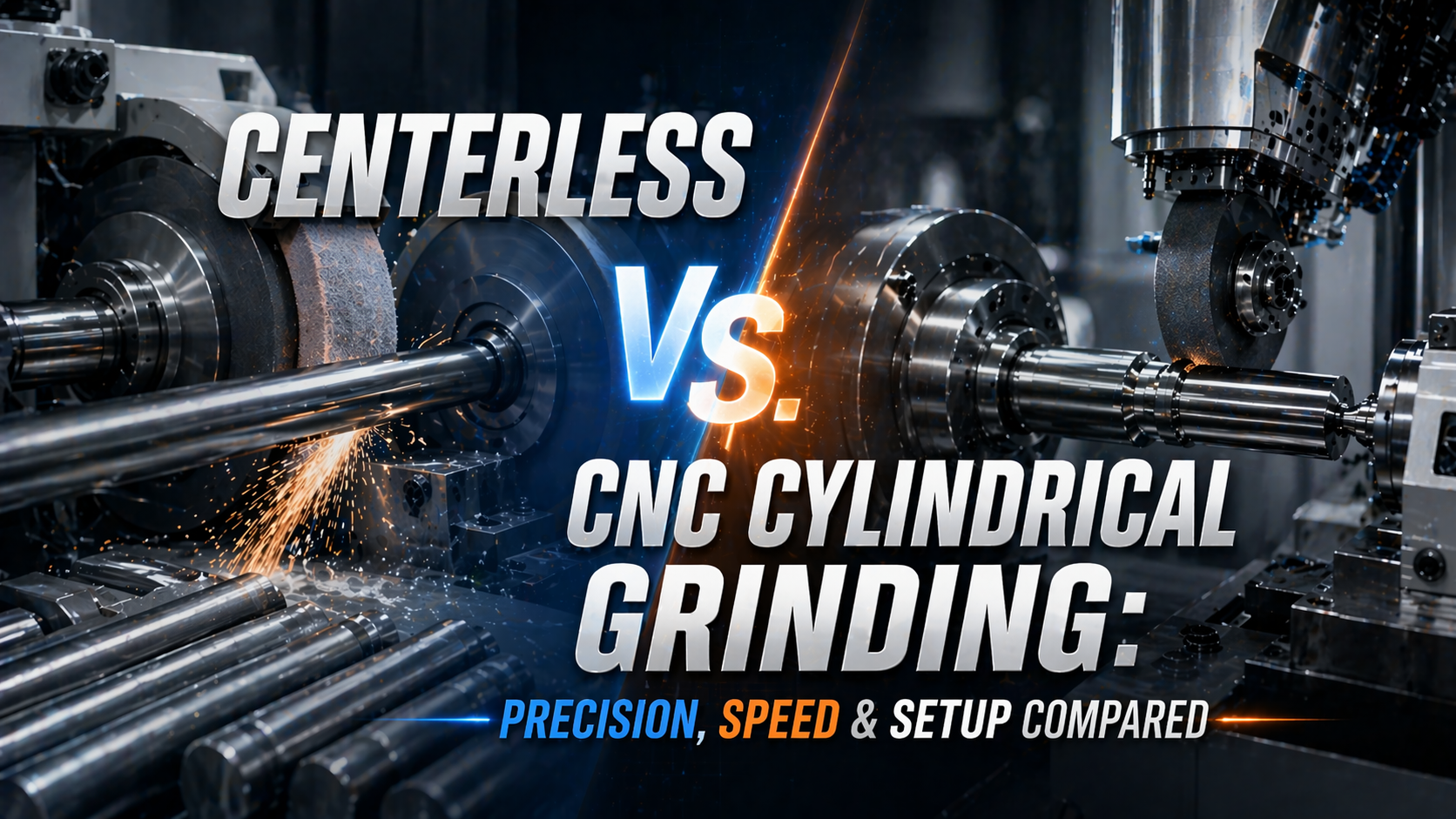
When it comes to achieving tight tolerances on cylindrical workpieces, manufacturers face a recurring decision: centerless grinding or CNC cylindrical grinding? Both methods remove material from round components, but the way they do it — and the results they deliver — are fundamentally different.
For engineers and procurement managers in industries like automotive, aerospace, and precision medical devices, choosing the wrong method can mean costly rework, missed tolerances, or production bottlenecks. In this article, GRIMA — with over 30 years of hands-on grinding machine experience — breaks down exactly how these two processes compare across three critical dimensions: precision, speed, and setup flexibility.
What Is Centerless Grinding?
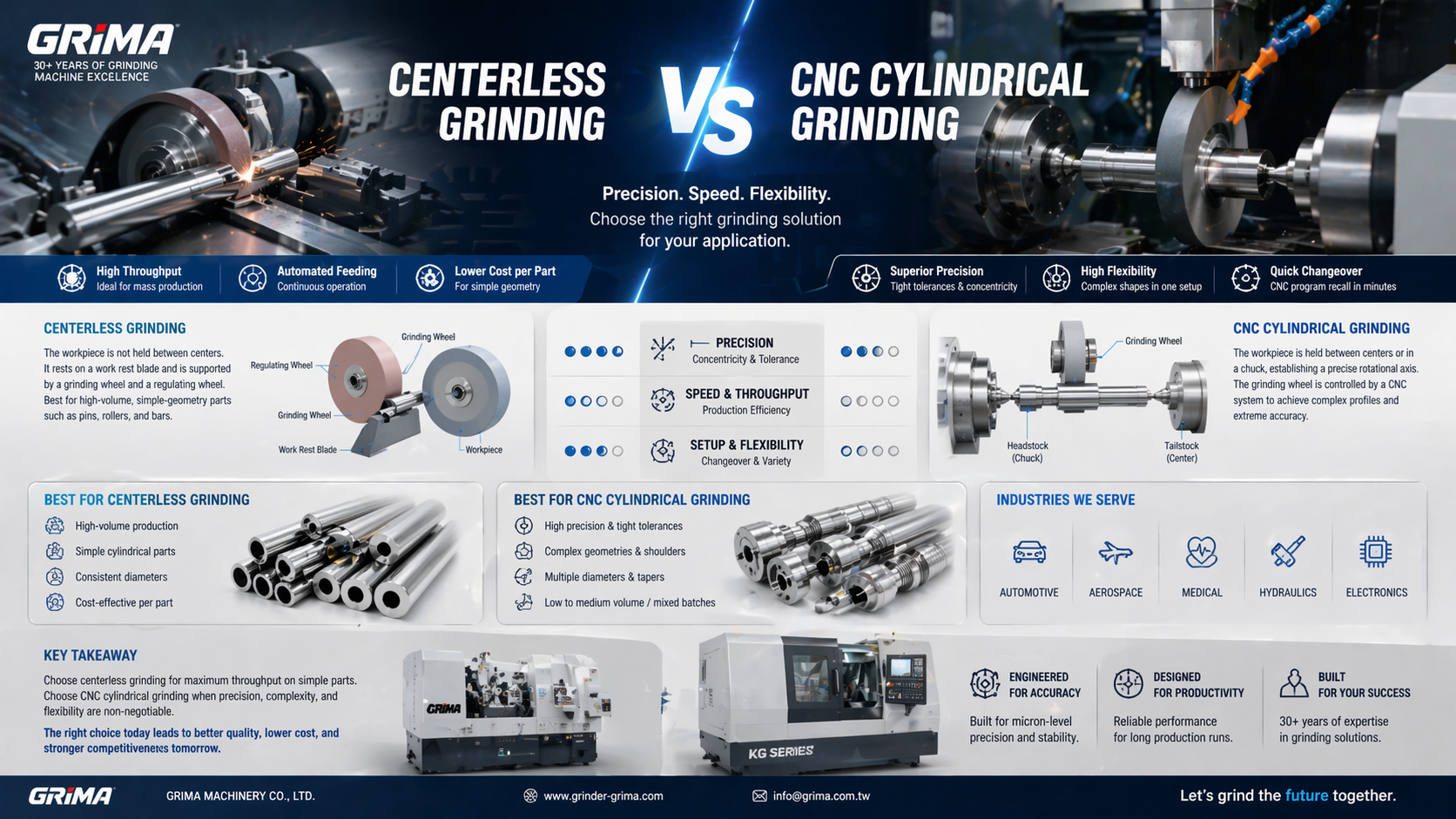
Centerless grinding is a process where the workpiece is not held between centers or clamped in a chuck. Instead, it rests on a work rest blade and is supported by two wheels: a grinding wheel that removes material, and a regulating wheel that controls the workpiece's rotation speed and feed rate.
This configuration allows for continuous, automated feeding of parts — making it highly efficient for high-volume, simple-geometry components such as pins, rollers, and bars. Because no fixturing is required, loading and unloading can be fully automated, enabling impressive cycle times at scale.
However, the absence of a fixed reference axis introduces limitations. Centerless grinding cannot control concentricity or grind stepped diameters, shoulders, or complex profiles in a single pass. It is, by design, a high-throughput process optimized for simple, repeatable geometries.
What Is CNC Cylindrical Grinding?
CNC cylindrical grinding — also known as OD (outside diameter) grinding — holds the workpiece between centers or in a chuck, establishing a precise rotational axis. The grinding wheel traverses along the workpiece or plunges radially into it, controlled by a multi-axis CNC system.
This method gives manufacturers full control over concentricity, roundness, taper angles, shoulder faces, and complex contour profiles — all within a single setup. Modern CNC cylindrical grinders, such as the GRIMA KG series, support internal and external grinding, angular head configurations, and compound operations that combine turning and grinding in one machine.
The result is unmatched dimensional accuracy and geometric flexibility, making CNC cylindrical grinding the preferred choice wherever precision cannot be compromised.
Precision Compared: Which Method Achieves Tighter Tolerances?
On a purely geometric level, CNC cylindrical grinding consistently achieves superior precision. Because the workpiece rotates about a fixed, defined axis, every pass of the grinding wheel references the same datum — a physical guarantee of concentricity and roundness that centerless grinding cannot replicate.
Centerless grinding is capable of excellent surface finish and diameter consistency, but it is susceptible to a phenomenon known as "lobing" — a form error caused by the workpiece not being referenced to a fixed center. For components where runout, concentricity, or angular features are specified, this is a critical limitation.
In applications such as aerospace turbine shafts, medical instrument spindles, or precision hydraulic valve bodies, where geometric tolerances are measured in microns, CNC cylindrical grinding is the only reliable method. GRIMA's CNC cylindrical grinders are engineered to deliver consistent accuracy across long production runs, ensuring that part one and part ten thousand meet the same exacting specifications.
If your drawing calls for concentricity, shoulder perpendicularity, or complex multi-diameter profiles, CNC cylindrical grinding is the clear choice.
Speed and Throughput: High Volume vs. Mixed Production
This is where centerless grinding earns its reputation. In through-feed mode, a centerless grinder can process hundreds — even thousands — of identical parts per hour with minimal operator intervention. For high-volume, single-diameter components, the throughput advantage is undeniable.
However, the picture changes significantly when part variety is introduced. Every time a new workpiece geometry or diameter is required, the centerless grinder must be re-dressed and reconfigured — a process that can take several hours per changeover. For job shops or manufacturers running mixed batches of diverse components, this overhead quickly erodes the speed advantage.
CNC cylindrical grinding, by contrast, handles changeovers through CNC program recalls and quick-change tooling, typically within minutes. GRIMA machines are designed with this production reality in mind: the KG series supports rapid parameter switching, allowing manufacturers to move seamlessly between job orders without sacrificing accuracy or wasting floor time.
Centerless grinding wins on single-part throughput; CNC cylindrical grinding wins on production flexibility and total operational efficiency across mixed batches.
Setup and Flexibility: Changeover Time and Workpiece Variety
Setup complexity is often the hidden cost in grinding operations. Centerless grinders require precise adjustment of the work rest height, regulating wheel angle, and wheel dressing parameters — all of which must be dialed in manually for each new workpiece. Experienced operators are essential, and setup errors directly translate into scrap.
CNC cylindrical grinders store all setup parameters digitally. Once a workpiece program is established and validated, it can be recalled instantly for repeat jobs — eliminating operator dependency and reducing setup-induced variation. For manufacturers running ISO-certified processes, this traceability and repeatability is not a luxury; it is a requirement.
Furthermore, CNC cylindrical grinders accommodate a far broader range of workpiece types: shafts with multiple steps, tapered bores, blind holes, and face grinding can all be completed in a single clamping. Centerless grinding, by its nature, is limited to through-feed or in-feed geometries — components with shoulders, flanges, or internal features require a completely different machine.
CNC cylindrical grinding offers dramatically greater setup traceability, faster changeovers for mixed production, and the geometric versatility that modern precision manufacturing demands.
Choosing the Right Method for Your Application
Use this reference to guide your decision:
| Application Requirement | Centerless Grinding | CNC Cylindrical Grinding |
|---|---|---|
| Ultra-high volume, single diameter | Ideal | Possible |
| Concentricity and runout control | Limited | Excellent |
| Stepped diameters and shoulders | Not suitable | Standard capability |
| Internal and external in one setup | No | Yes (compound machines) |
| Mixed batch / job shop production | Slow changeover | Fast CNC recall |
| Medical, aerospace, defense parts | Geometry-dependent | Preferred method |
Why GRIMA CNC Cylindrical Grinders Are Built for Precision Manufacturing
At GRIMA (Guan-Yu Machinery Co., Ltd.), every machine in the KG series is engineered around one principle: high speed, excellent accuracy, top quality, and superior efficiency — without compromise.
Our CNC cylindrical grinders, including the KG-150 series, KG-500 series, and the compound KG-1200IE, are trusted by manufacturers across automotive, aerospace, precision mold, and medical device sectors. Each machine is designed for real production environments — where uptime matters, changeovers must be fast, and tolerances are non-negotiable.
Whether you need OD grinding, ID grinding, or a compound solution that combines turning and grinding in a single platform, GRIMA has a proven machine configuration to match your production requirements.
Conclusion: Precision Wins Where It Counts
Centerless grinding remains a powerful tool for high-volume, simple-geometry production. But for manufacturers where accuracy, flexibility, and process traceability define competitive advantage, CNC cylindrical grinding is the superior investment.
The question is not simply which method is faster — it is which method consistently delivers the quality your customers require, across every job, every shift, every year.
Ready to explore the right GRIMA CNC cylindrical grinder for your production line?
Contact Guan Yu's engineering team for a free application consultation and machine recommendation.