


In precision manufacturing, every additional setup is a liability. Each time a workpiece is unclamped, repositioned, and re-fixtured on a different machine, you introduce the risk of dimensional deviation, extend your cycle time, and consume floor space that could be generating output. For manufacturers in the automotive, aerospace, and medical sectors — where tolerances are measured in microns and delivery schedules are unforgiving — this is not a theoretical concern. It is a daily constraint on profitability.
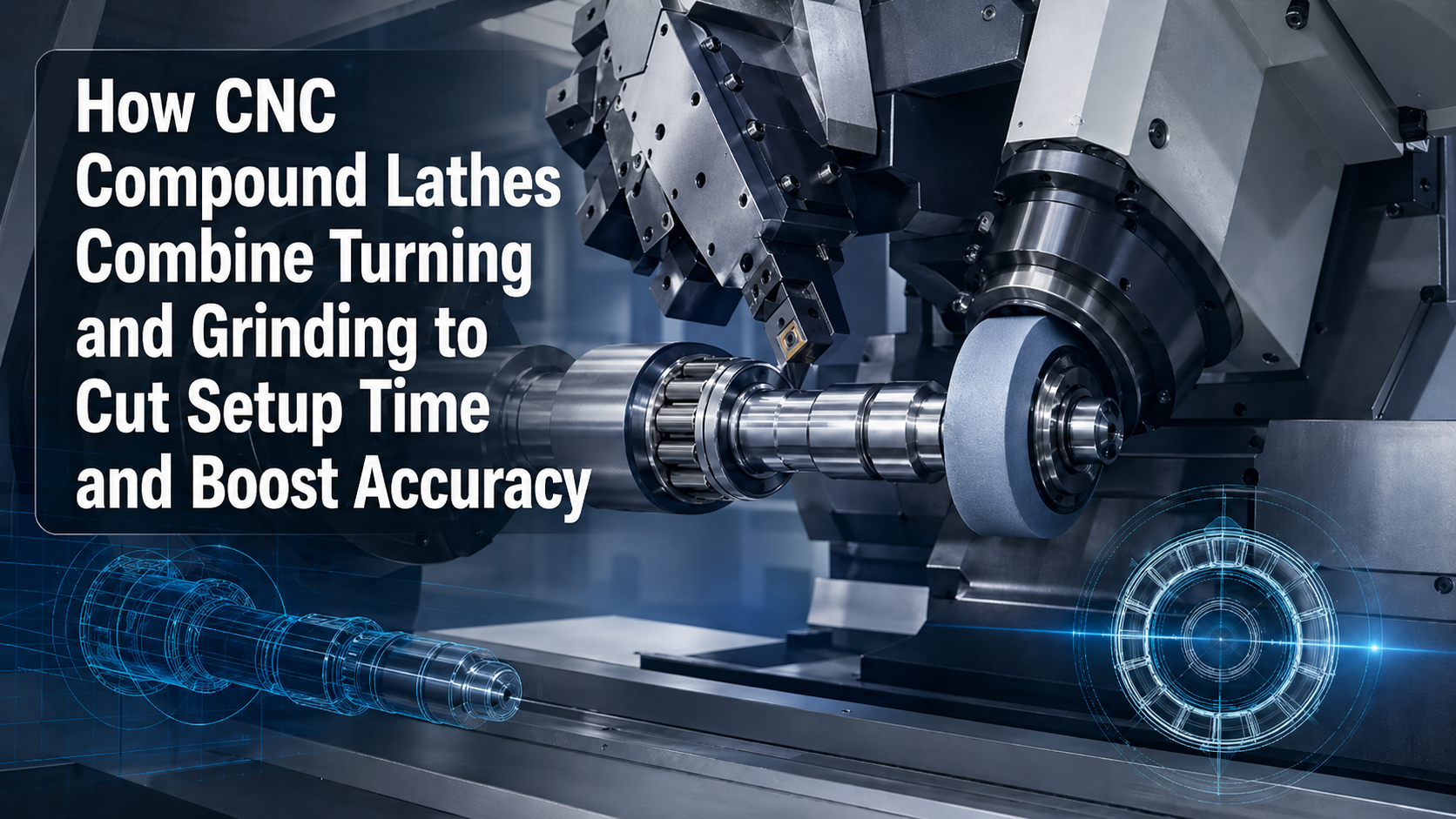
The CNC compound lathe addresses this constraint directly. By integrating turning and grinding into a single machine platform, it eliminates the inter-process transfer that conventional workflows depend on. This article explains how CNC compound lathes work, where they outperform separate-machine setups, and what specifications matter when evaluating one for your production line.
What Is a CNC Compound Lathe?
A CNC compound lathe — also referred to as a CNC turning-grinding complex machine — is a machine tool that combines rotational turning operations and precision grinding within a single setup. Rather than completing turning on a CNC lathe and then transferring the workpiece to a cylindrical grinder for finishing, both processes occur on the same machine, with the same workpiece datum, without reclamping.
Modern CNC compound lathes support a range of operations in one setup:
- Internal diameter (ID) turning and grinding
- External diameter (OD) turning and grinding
- End face turning and grinding
- Chamfer machining
- Taper and contour operations
This multi-process capability is enabled by a machine architecture that houses both turning tooling and a grinding spindle within the same CNC-controlled workspace. Advanced models offer single-spindle, dual-spindle, and multi-spindle configurations, allowing manufacturers to tailor the machine to their specific part family and production volume.
What Is a Single-Process Machine Setup?
A single-process setup refers to the conventional workflow where turning and grinding are performed on separate, dedicated machines. A workpiece is first rough-turned and semi-finished on a CNC lathe, then transferred — manually or via automation — to a cylindrical grinding machine for final finishing and dimensional sizing.
This approach has historically been standard practice because dedicated machines optimize for a single operation. A purpose-built cylindrical grinder delivers excellent surface finish on OD features; a dedicated CNC lathe offers fast material removal rates during roughing. When your production volume is high and your part geometry is simple, this segregated approach can be cost-effective.
However, single-process setups carry structural inefficiencies that compound as part complexity increases: multiple fixtures, multiple setups, accumulated positional errors, and longer total lead times per part.
1. Setup Time and Workflow Efficiency
The most immediate benefit of a CNC compound lathe is the elimination of inter-machine transfer. In a conventional workflow, the time between completing turning and beginning grinding includes unloading, transport, queue time at the grinder, fixturing, and datum re-establishment. Depending on shop floor layout and batch size, this non-cutting time can represent 30–50% of total part lead time.
A compound lathe collapses this to zero. Once the workpiece is chucked, it remains in position through both the turning and grinding phases. Program transitions between operations are controlled by the CNC system — operators do not intervene between processes. For high-mix, low-to-medium volume production environments, this translates directly into measurable reductions in parts-per-shift lead time and work-in-progress inventory.
For manufacturers running multiple part numbers per shift, the reduction in setup changeover frequency also compounds the efficiency gain across the production day.
2. Dimensional Accuracy and Concentricity
When a workpiece is transferred between two separate machines, the act of reclamping introduces a new source of error. Even with high-quality fixturing, repositioning a workpiece on a different machine spindle creates runout deviation that must either be toleranced into the part specification or corrected through additional grinding passes.
For components that require tight concentricity between internal and external features — such as bearing housings, hydraulic valve bodies, and precision spindle sleeves — this inter-machine repositioning error is a critical quality risk. Achieving concentricity of 0.003 mm or better between an internal bore and an external diameter is genuinely difficult when the two features are machined on different platforms.
A CNC compound lathe eliminates this variable. Because both internal and external features are machined on the same spindle, in the same setup, from the same datum, concentricity is a function of machine geometry rather than setup skill. Manufacturers consistently report tighter concentricity and more repeatable dimensional output when consolidating turning and grinding on a single platform.
3. Cost Per Part and Floor Space
The economic case for a CNC compound lathe depends on two factors: the complexity of your parts and the cost of your floor space. On a per-machine basis, a compound lathe carries a higher initial investment than either a standalone CNC lathe or a cylindrical grinder. However, the total cost of ownership calculation shifts when you account for the machines being replaced.
One compound lathe replacing two separate machines means one set of preventive maintenance contracts, one operator qualification requirement, and one machine footprint on the factory floor. For facilities in high-cost manufacturing regions where floor space is priced at a premium, this consolidation has direct financial value. For operations expanding capacity without expanding their building footprint, it enables higher output density per square meter.
Additionally, reduced setup labor and shorter cycle times per part lower the variable cost component of production, improving margin on precision components that command value-based pricing.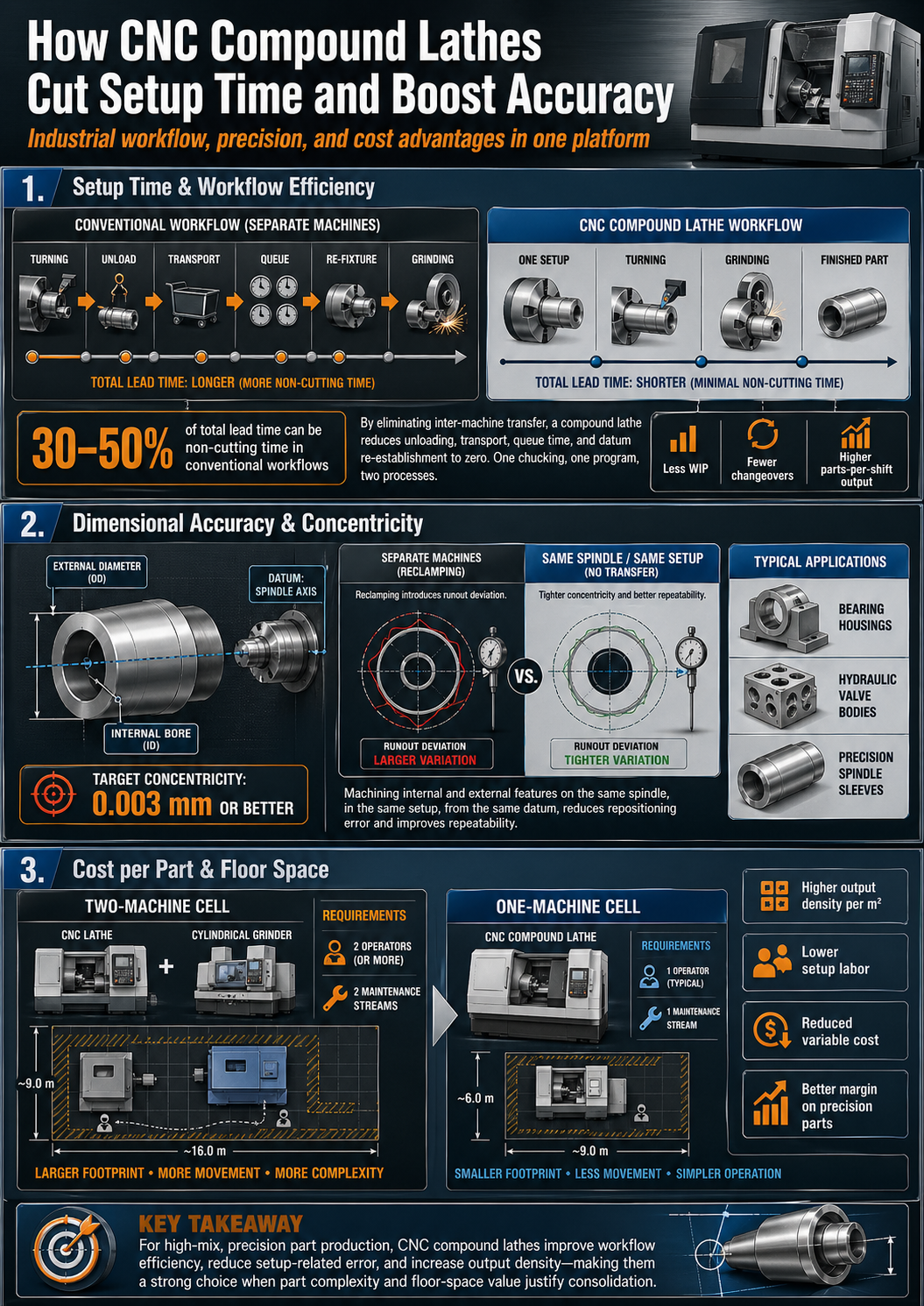
CNC Compound Lathe vs. Single-Process Setup: Quick Comparison
| Factor | CNC Compound Lathe | Separate CNC Lathe + Grinder |
|---|---|---|
| Setup Count per Part | 1 | 2 or more |
| Inter-Machine Transfer | Eliminated | Required |
| Concentricity Control | Single-datum, highest accuracy | Dependent on reclamping precision |
| Lead Time per Part | Shorter | Longer |
| Floor Space Required | 1 machine footprint | 2+ machine footprints |
| Initial Investment | Higher (single machine) | Lower per unit, higher combined |
| Operator Requirement | 1 qualified operator | Multiple machine operators |
| Best For | Complex parts, tight tolerances, mixed production | High-volume, simple geometry, dedicated lines |
| Maintenance Complexity | Moderate (one system) | Higher (two systems) |
| Ideal Industries | Aerospace, medical, precision molds, automotive | High-volume automotive, commodity turning |
Why Manufacturers Choose GRIMA's CNC Turning-Grinding Complex Machines
GRIMA's KG-400IE and KG-1200IE CNC Internal External Turning Grinding Complex Machines are purpose-engineered for manufacturers who cannot compromise on concentricity, surface finish, or cycle efficiency.
Developed by Guan-Yu Machinery Co., Ltd. — a Taiwan-based precision machine tool manufacturer with over 30 years of engineering experience — the KG-400IE and KG-1200IE support ID grinding, OD grinding, end face grinding, and chamfer machining in a single setup. Available in single-spindle, dual-spindle, and multi-spindle configurations, both models are engineered to accommodate diverse part families across the automotive, aerospace, precision mold, and medical device sectors.
GRIMA machines are built on the same engineering platform as the company's flagship cylindrical grinding series, ensuring that the grinding performance in their compound machines meets the same standards as their dedicated grinders. A highly intuitive human-machine interface reduces programming time, while the machine's structural rigidity supports consistent concentricity control across extended production runs.
With an established global distributor network and a team that provides custom configuration consultation, GRIMA delivers compound machining solutions tailored to your part geometry, production volume, and precision targets.
Conclusion
CNC compound lathes represent a structural improvement in how precision parts are manufactured — not simply a convenience. By consolidating turning and grinding into a single setup, they eliminate the repositioning errors, transfer delays, and multi-machine overhead that limit throughput and precision in conventional workflows.
For manufacturers producing components with demanding concentricity requirements, tight surface finish specifications, or complex geometry that benefits from multi-process consolidation, a CNC compound lathe is a strategically sound investment. The question is not whether compound machining delivers better outcomes — the engineering case is clear. The question is whether your current part mix and production volume justify the transition.
If you are producing precision components for aerospace, automotive, medical, or mold applications and want to evaluate whether a compound lathe is the right fit, GRIMA's engineering team is prepared to help you assess the specification.
Evaluate a CNC Compound Lathe for Your Production Line
Contact GRIMA to discuss your part geometry, tolerance requirements, and production volume with our technical team. We will provide detailed specifications for the KG-400IE or KG-1200IE and a configuration recommendation matched to your manufacturing objectives.
BACK