


When evaluating machine tool investments, procurement managers and production engineers frequently face one critical question: should you invest in a CNC lathe machine or a turning center? Both perform rotational cutting operations, yet they serve fundamentally different production needs. Choosing the wrong machine can result in excess capital expenditure, lower throughput, or precision shortfalls that cost you contracts.
This guide breaks down the core differences between CNC lathe machines and turning centers - covering machine architecture, precision performance, production flexibility, and total cost of ownership — so you can make a confident, data-driven decision for your facility.
What Is a CNC Lathe Machine?
A CNC lathe machine is a computer-numerically controlled machine tool designed to rotate a workpiece along a fixed axis while cutting tools remove material to produce cylindrical, conical, or threaded components. The cutting motion is primarily two-axis (X and Z), making CNC lathes ideal for high-precision turning, facing, boring, and threading operations on round components.
CNC lathes are the backbone of industries that demand tight dimensional tolerances — automotive shafts, hydraulic cylinders, medical implants, and precision mold components. Their rigid single-spindle design minimizes vibration, which is essential when working with hard alloys or achieving surface finishes below Ra 0.4 μm.
Key characteristics of a CNC lathe machine:
- Two-axis or multi-axis turning (X, Z, and optional C-axis)
- High-rigidity one-piece casting bed
- Designed for batch or high-volume single-part-type production
- Superior surface finish and dimensional accuracy
- Lower initial investment compared to full turning centers
What Is a Turning Center?
A turning center is an advanced evolution of the CNC lathe, integrating live tooling, milling capability, and often a secondary spindle into a single machine platform. While it shares the rotational cutting principle of a lathe, a turning center can perform drilling, milling, and tapping on a workpiece without repositioning — combining what would otherwise be separate lathe and machining center operations.
Turning centers typically feature Y-axis movement, live tool turrets, and automation-ready designs for integration into flexible manufacturing systems.
Key characteristics of a turning center:
- Multi-axis capability (X, Z, Y, C, and sometimes B-axis)
- Live tooling for milling, drilling, and tapping
- Sub-spindle for complete part machining in one setup
- Higher machine complexity and footprint
- Significantly higher capital investment
1. Precision and Surface Finish
For pure turning operations, a dedicated CNC lathe machine often outperforms a turning center in surface finish consistency. The reason is structural: a CNC lathe is optimized entirely around rotational cutting, with a more rigid spindle bearing arrangement and reduced thermal displacement. When your parts require cylindricity tolerances below 0.005 mm or surface roughness values of Ra 0.2 μm, a purpose-built CNC lathe is the safer specification.
Turning centers introduce more thermal variables due to their integrated milling spindles and live tool motors. For complex prismatic-round parts where milling flats and drilling cross-holes occur in the same setup, turning centers eliminate repositioning errors that would accumulate across multiple machines — making them more accurate for multi-feature complex parts.
Verdict: CNC lathe for pure-turning precision; turning center for complex multi-feature part accuracy.
2. Production Flexibility and Setup Time
Turning centers win decisively on flexibility. A single setup can complete a part that would require two or three separate machine operations on a conventional CNC lathe line. For job shops and contract manufacturers producing diverse part families, this reduces work-in-progress inventory and cuts total lead time significantly.
CNC lathes excel at dedicated high-volume production. When your line runs thousands of identical shafts or bushings per month, the simplicity of a CNC lathe — fewer axes to program, faster cycle times, simpler maintenance — translates directly into lower cost-per-part and higher overall equipment effectiveness (OEE).
Verdict: Turning center for mixed-part job shop environments; CNC lathe for high-volume dedicated production.
3. Total Cost of Ownership
A CNC lathe machine typically costs 30–60% less than a comparable turning center, with lower tooling costs, simpler programming requirements, and reduced maintenance complexity. For facilities with straightforward turning requirements, investing in a turning center means paying for capabilities you may rarely use.
Turning centers carry higher operating costs: live tool maintenance, more complex CNC control systems, and higher-skilled operators. However, when a turning center consolidates three machining steps into one, the total cost per part can be lower than running multiple CNC lathes. The break-even depends entirely on your part mix and production volumes.
Verdict: CNC lathe for lower TCO in single-operation environments; turning center pays back when consolidating multi-step processes.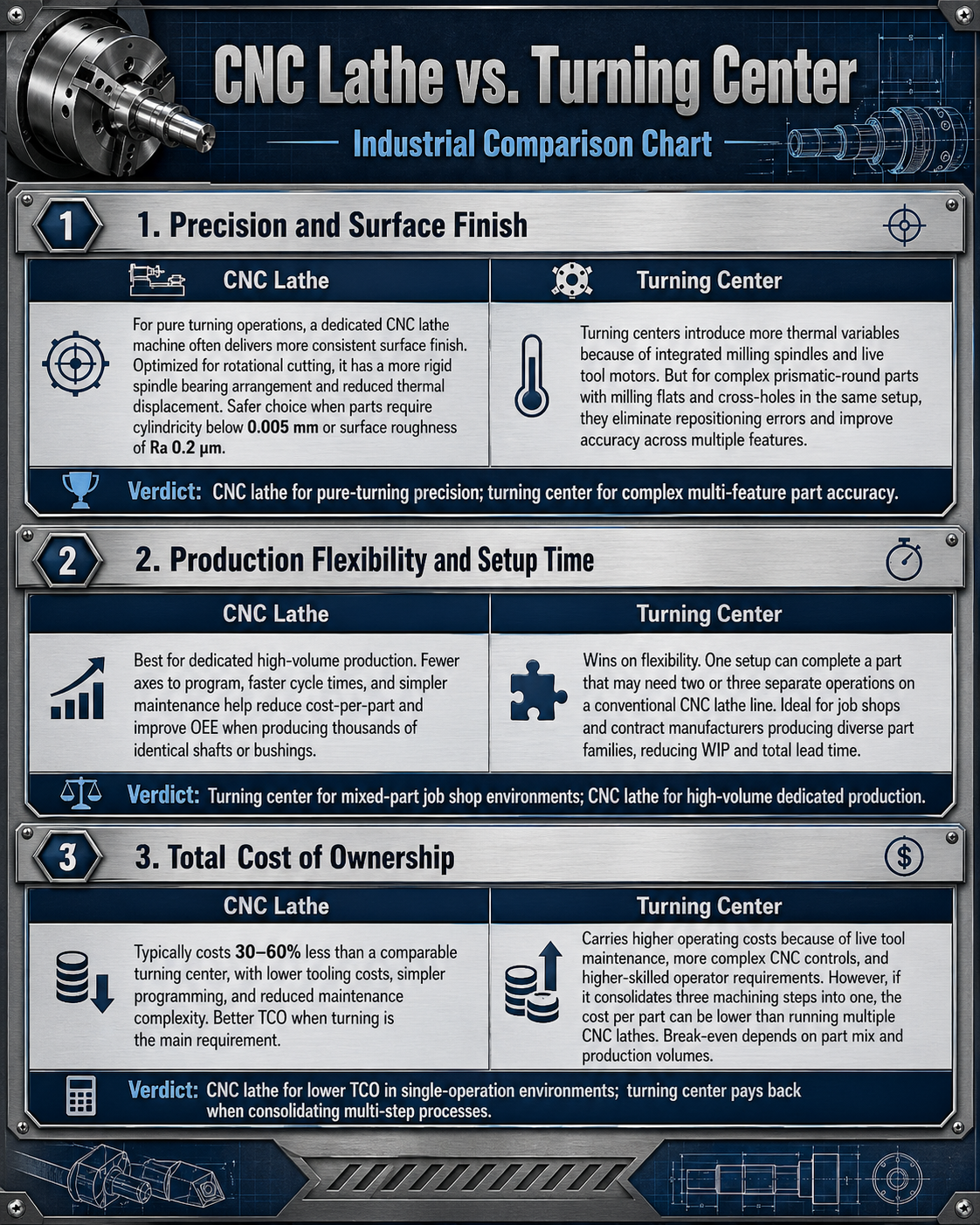
CNC Lathe vs. Turning Center: Quick Comparison
| Specification | CNC Lathe Machine | Turning Center |
|---|---|---|
| Primary Operation | Turning, facing, threading, boring | Turning + milling + drilling in one setup |
| Axis Count | 2–3 axes (X, Z, C) | 4–6 axes (X, Z, Y, C, B + sub-spindle) |
| Live Tooling | No (standard) | Yes |
| Surface Finish | Ra 0.2 μm and below | Ra 0.4 μm typical |
| Setup Complexity | Low | High |
| Capital Investment | Lower | 30–60% higher |
| Best For | High-volume single-operation turning | Complex multi-feature parts, job shops |
| Operator Skill | Moderate | High |
| Maintenance | Low complexity | High complexity |
| Ideal Industries | Automotive, medical, shafts/cylinders | Aerospace, mold components, mixed production |
Why Manufacturers Choose GRIMA's KL-400 CNC Lathe
For production lines focused on precision turning of cylindrical components, GRIMA's KL-400 CNC Lathe delivers the rigidity, accuracy, and reliability that B2B manufacturers in automotive, aerospace, and medical sectors demand.
Developed by Guan-Yu Machinery Co., Ltd. — a Taiwan-based precision machine tool manufacturer with over 30 years of hands-on experience in metal processing — the KL-400 is engineered for high-volume production environments where dimensional consistency and surface finish are non-negotiable. GRIMA's engineering team provides customized configuration support, ensuring the KL-400 integrates seamlessly into your existing production workflow.
With an established global distributor network and a proven track record across defense, precision molds, and medical device manufacturing, GRIMA delivers not just machines — but long-term manufacturing partnerships built on the company's core values of high speed, excellent accuracy, top quality, and superior efficiency.
Conclusion
The choice between a CNC lathe machine and a turning center comes down to three factors: part complexity, production volume, and total cost of ownership targets. If your production line runs high volumes of precision cylindrical components and demands the tightest tolerances at the lowest cost per part, a CNC lathe machine is the right investment. If your facility handles diverse, complex parts that benefit from consolidated multi-operation setups, a turning center may justify its higher price point.
For manufacturers prioritizing precision, reliability, and cost-efficiency in dedicated turning operations, GRIMA's KL-400 CNC Lathe is a proven solution backed by decades of precision engineering expertise from Taiwan.
Ready to Specify the Right CNC Lathe for Your Production Line?
Contact GRIMA's engineering team for technical consultation, detailed specifications, and a customized quotation for the KL-400 CNC Lathe. Our specialists will evaluate machine configurations matched to your exact production requirements.
BACK